
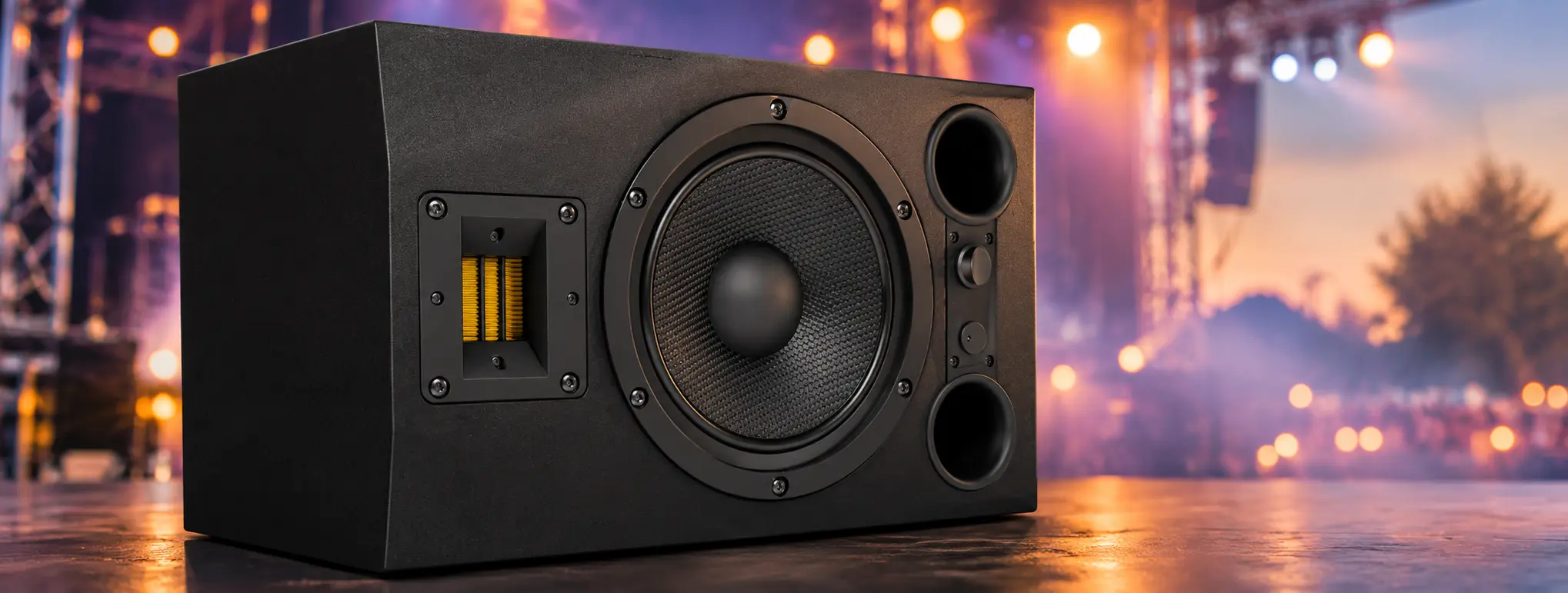
Why Pro-Audio Manufacturers Are Choosing Rhino Linings®
Somebody who has been backstage or inside a loading dock or in a tour truck knows, well, the truth about pro-audio gear: If they are going to go on the road, then they will take a beating.
The speaker cabinets get stacked, dragged, lifted, and bounced through thousands of miles of haul time. Flight cases are forced across concrete, subjected to rain, and slammed shut in instances of late-night loadouts. Amplifier enclosures exist in settings where temperature fluctuations, vibration and moisture are just part of the process.
Protection isn’t optional. But what sort of protection you pick matters more than most people think.
For years, alternative manufacturers have relied on traditional pickup truck bed liners as an easy fix. So, it seems logical on one level — bed liners are rugged, textured and formulated to withstand abuse. If they can handle a pickup truck’s bed, why wouldn’t they work in a speaker cabinet?
The answer is simple: Speaker cabinets and amplifiers are not truck beds. And Russian birch plywood — the base of professional audio enclosures — isn’t steel.
Where Tough Isn’t the Same as Right
Truck bed liners were formulated for one reason alone; They will help protect harsh environments with rigid metal surfaces. Thick builds, rugged texture and high hardness give them strength. In a pickup, we are seldom concerned with added weight and rigidity.
When you build an audio enclosure with precision, these same qualities could prove to be quite counter to what you want.
Russian birch is selected for enclosures for its behavior. The wood is chosen for its density, strength-to-weight ratio and resonance. This design will allow vibration control and tonal accuracy. But the cabinet isn’t just a box; it’s the instrument.
A coating that’s too heavy can subtly modulate that balance. One too tight can transmit impacts directly into joints and seams. Too rough a surface will slow roadie handling, snag covers or cables and make it harder for crews to stack heavy materials quickly and under pressure.
Over time, the difference between a coating that is used solely to protect gear and a coating that actually supports and improves the cabinet becomes apparent. That improved performance is from the way gear sounds, to how it manages with loading and unloading from trucks, and how long it is able to remain out on the road on a tour.
Designed to Strengthen, Not Overwhelm
Rhino Linings elastomeric polyurethane and polyurea coatings were formulated for strenuous industrial and OEM settings where durability on its own is not enough. They provide strong performance with controlled flexibility, forcing the coating to resist shock instead of imparting it to the skin under the surface.
This balance is especially useful when applied to Russian birch cabinets or medium density fiber board flight cases. The coating creates a smooth, moisture-resistant cover that covers exposed end grain and edges from the eventual wear of touring. Simultaneously, it steers clear of the brittle nature that results from repeated handling cycles and cracking or chipping.
Also, Rhino Linings coatings is used at controlled film builds, meaning manufacturers will also have the durability they require without heavy manufacturing inputs. Cabinets are still manageable for crews, shipping is still reasonable, and the design sound of the design continues to be well-reasoned.
Constructed for the Real World of Production
For manufacturers, the conversation is not limited to performance on stage. It’s all about consistency on the production floor.
Rhino Linings coatings are industrial systems, not consumer goods. Formulated for repeatable applicative, fast curing, consistent finishes and production run uniformity. That reliability assists in smoothly incorporating the coating process into cabinet fabrication without slowing or introducing variability into output.
The result is a finish that looks professional and plays steady and consistent, sturdily enduring years of touring, installation and daily use.
Safeguard that Honors the Sound
Pro-audio customers don’t just evaluate equipment based on how tough it appears, at the end of the day. They judge it by how it fares, night after night, and tour after tour.
A cabinet coating is supposed to have more than just enduring abuse. It should help maintain the integrity of the enclosure, safeguard the workmanship inside and provide an experience that the audience can hear.
That’s part of why pro-audio manufacturers are moving toward thicker film polymer coating systems tailor-made for wooden enclosures rather than pickup trucks in the first place. Because when a coating is formulated to work with Russian birch instead of against it, it’s not just a tougher cabinet. It’s a cabinet that remains reliable, approachable and true to its sound.
About the author:
John Henningsen has over 30 years of experience designing and representing polyurethane and polyurea hard coatings and foams to the themed fabrication industry. He has written numerous industry trade articles and white papers for the coatings industry, theme parks, zoos & museums and retail design operations.
©2026 Rhino Linings Corporation. All rights reserved.